
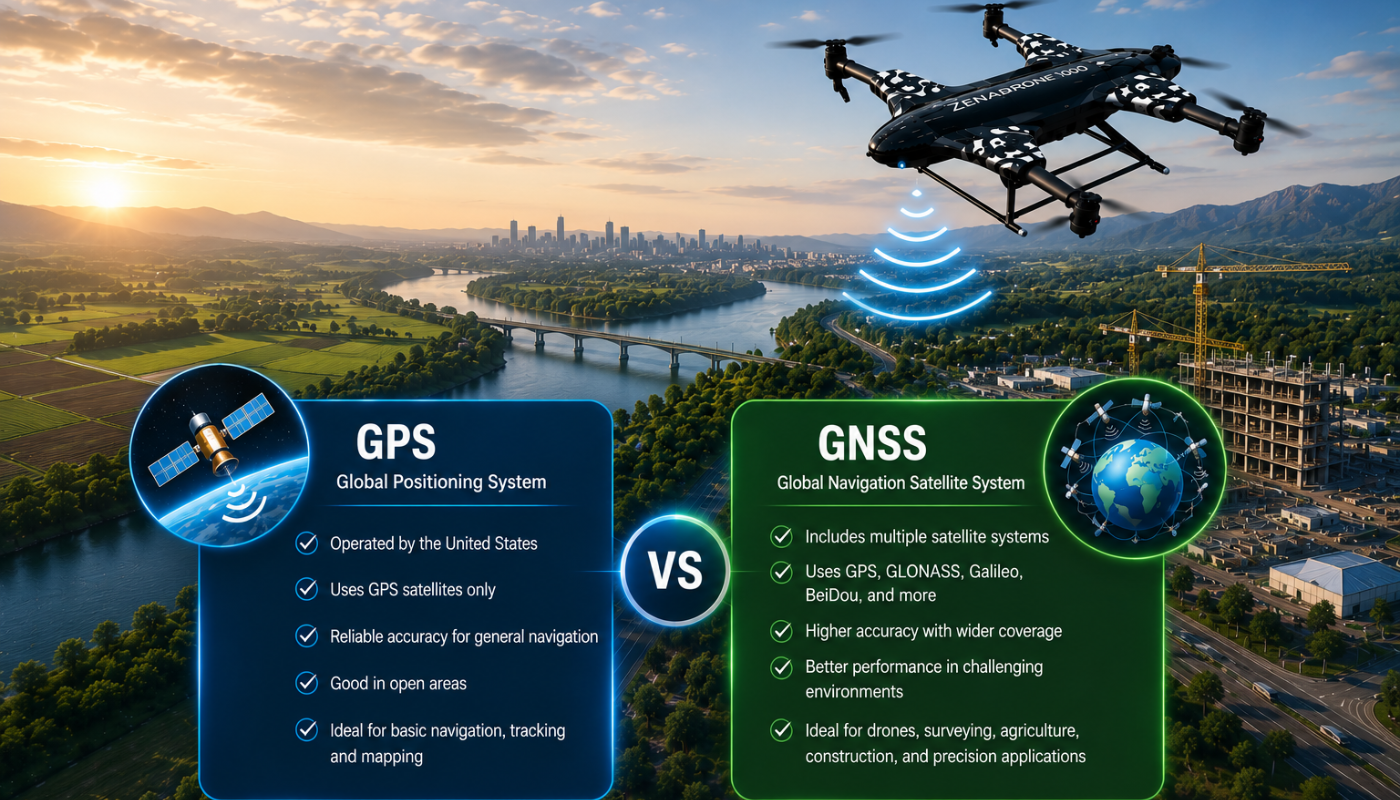
Satellite navigation technology has become an essential part of modern life, powering everything from smartphones and vehicles to drones and surveying equipment. While many people use the terms GPS and GNSS interchangeably, they are not exactly the same. Understanding the GNSS and GPS Comparison is important for professionals working in industries such as agriculture, construction, mapping, surveying, logistics, and drone operations.
As navigation systems continue to evolve, businesses and organizations increasingly rely on highly accurate positioning data to improve efficiency and decision-making. Knowing the differences between GNSS and GPS helps users choose the right technology for their specific applications and operational requirements.
What Is GPS?
GPS, or the Global Positioning System, is a satellite navigation system developed and operated by the United States government. Originally designed for military purposes, GPS is now widely available for civilian use around the world.
The GPS network consists of a constellation of satellites orbiting the Earth. These satellites continuously transmit signals that GPS receivers use to determine their location, speed, and time.
GPS has become one of the most widely used positioning technologies because it provides reliable navigation services across various industries. From vehicle navigation systems to smartphone applications, GPS plays a critical role in everyday operations.
Key Features of GPS
- Operated by the United States
- Provides global positioning and navigation services
- Offers location, velocity, and timing information
- Widely used in commercial and consumer applications
- Supports navigation, tracking, and mapping activities
What Is GNSS?
GNSS stands for Global Navigation Satellite System. Unlike GPS, GNSS is not a single navigation system. Instead, it is a general term used to describe all satellite navigation systems worldwide.
GNSS includes multiple satellite constellations that work independently or together to provide positioning and navigation services. These systems include:
- GPS (United States)
- GLONASS (Russia)
- Galileo (European Union)
- BeiDou (China)
A GNSS receiver can access signals from multiple satellite systems simultaneously, improving positioning accuracy, reliability, and availability.
Key Features of GNSS
- Includes multiple satellite navigation systems
- Provides broader satellite coverage
- Improves signal availability
- Enhances positioning accuracy
- Supports advanced navigation applications
GNSS and GPS Comparison
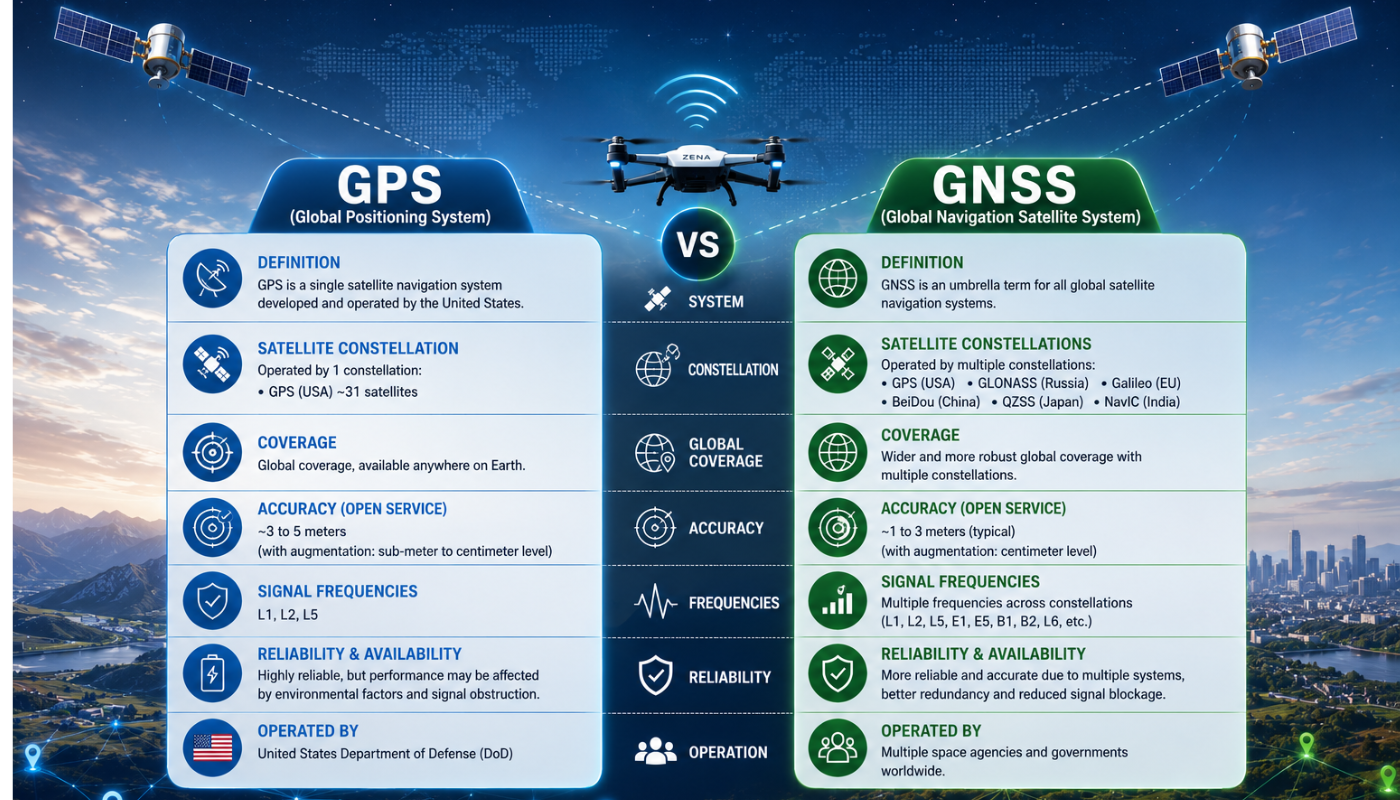
The most important distinction in the GNSS and GPS Comparison is that GPS is one specific satellite navigation system, while GNSS refers to all global satellite navigation systems collectively.
| Feature | GPS | GNSS |
|---|---|---|
| Full Form | Global Positioning System | Global Navigation Satellite System |
| System Type | One specific satellite navigation system | Collection of multiple satellite navigation systems |
| Operated By | United States | Multiple countries and regions |
| Satellite Access | Uses GPS satellites only | Uses GPS, GLONASS, Galileo, BeiDou, and more |
| Accuracy | Reliable accuracy for general navigation | Higher accuracy due to more satellite coverage |
| Reliability | Good in open areas | Better in challenging environments |
| Best For | Basic navigation, tracking, and mapping | Drones, surveying, agriculture, construction, and precision mapping |
This distinction becomes increasingly important when high-precision positioning is required.
Why GNSS Is More Advanced Than GPS
Modern navigation equipment often uses GNSS technology because it provides access to a larger number of satellites. More satellites mean better signal coverage and improved positioning accuracy.
Increased Satellite Availability
GPS receivers rely solely on GPS satellites. GNSS receivers, however, can connect to multiple satellite systems simultaneously.
This broader coverage improves signal reception in environments where obstacles such as buildings, mountains, or dense vegetation may interfere with navigation signals.
Enhanced Accuracy
One major advantage highlighted in any GNSS and GPS Comparison is improved accuracy. Access to more satellites allows GNSS receivers to calculate positions more precisely.
This enhanced accuracy is particularly valuable in industries such as:
- Drone operations
- Land surveying
- Precision agriculture
- Construction
- Infrastructure inspection
Greater Reliability
Because GNSS utilizes multiple satellite networks, users experience fewer interruptions. If one system experiences issues or signal degradation, other satellite constellations can continue providing positioning data.
This redundancy ensures more reliable navigation performance in demanding environments.
Applications of GNSS and GPS Technology
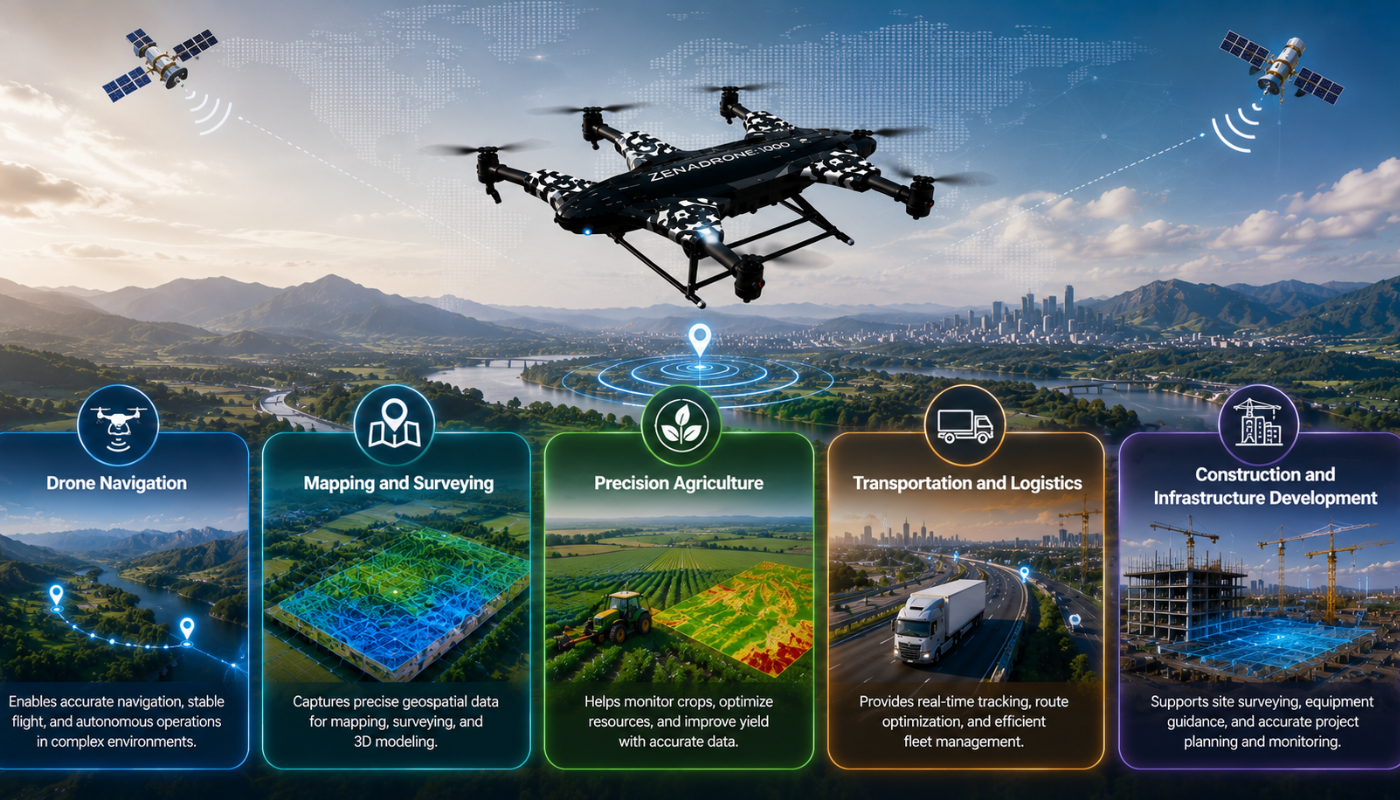
Drone Navigation
Drones rely heavily on satellite positioning technology for navigation, route planning, and autonomous flight operations.
Modern commercial drones increasingly use GNSS receivers rather than GPS-only systems. Access to multiple satellite constellations improves flight stability and positioning accuracy.
Accurate navigation is especially important for:
- Mapping missions
- Infrastructure inspections
- Agricultural monitoring
- Security surveillance
- Search and rescue operations
Mapping and Surveying
Surveying professionals require highly accurate positioning information to create maps, measure land boundaries, and support infrastructure projects.
GNSS technology provides centimeter-level accuracy when combined with correction systems such as RTK (Real-Time Kinematic) positioning.
This capability makes GNSS an essential tool for modern surveying operations.
Precision Agriculture
Farmers use satellite navigation technology to optimize planting, irrigation, fertilization, and harvesting activities.
A detailed GNSS and GPS Comparison reveals that GNSS offers greater accuracy for precision agriculture applications, enabling better resource management and improved crop yields.
Transportation and Logistics
Navigation systems help transportation companies optimize routes, monitor vehicle locations, and improve fleet management.
GNSS technology enhances tracking accuracy and provides more reliable positioning data across different geographic regions.
Construction and Infrastructure Development
Construction projects require accurate positioning for site planning, grading, equipment guidance, and project management.
GNSS technology enables construction professionals to complete projects more efficiently while maintaining high levels of accuracy.
Factors Affecting Navigation Accuracy
Several factors influence the accuracy of GPS and GNSS systems.
Number of Visible Satellites
The more satellites available to a receiver, the more accurate its positioning calculations become.
GNSS receivers typically have access to significantly more satellites than GPS-only devices.
Environmental Conditions
Buildings, trees, tunnels, and mountainous terrain can obstruct satellite signals.
GNSS systems generally perform better in challenging environments because they can access multiple satellite networks.
Atmospheric Interference
Satellite signals travel through the Earth’s atmosphere, where they may experience slight delays.
Modern GNSS receivers use advanced correction techniques to minimize these effects and improve positioning accuracy.
Receiver Quality
The quality of the navigation receiver also impacts performance. High-end GNSS receivers often provide superior accuracy compared to basic GPS devices.
GNSS Technology in Modern Drone Operations
As drone technology continues to advance, GNSS has become a critical component of professional drone systems.
Commercial drones rely on GNSS for:
- Autonomous navigation
- Waypoint missions
- Precision landing
- Geofencing
- Aerial mapping
- Inspection services
By utilizing multiple satellite constellations, GNSS-equipped drones can maintain stable positioning even in challenging operational environments.
This capability is particularly valuable for industrial and commercial applications where accuracy directly impacts operational success.
The Future of Satellite Navigation
The future of navigation technology is centered around improving accuracy, reliability, and integration with emerging technologies.
Satellite navigation systems are expected to become even more sophisticated through:
- Artificial intelligence integration
- Real-time correction services
- Enhanced satellite coverage
- Advanced drone navigation systems
- Smart city infrastructure
As GNSS technology continues to evolve, industries will gain access to increasingly accurate positioning data that supports automation, efficiency, and innovation.
ZenaDrone and Advanced GNSS Navigation Technology
ZenaDrone integrates advanced GNSS technology into its drone solutions to deliver highly accurate positioning, navigation, and mapping capabilities. By utilizing multiple satellite constellations, Zena Drone platforms achieve greater precision and reliability than traditional GPS-only systems. This enhanced navigation performance supports critical applications such as aerial surveying, infrastructure inspections, precision agriculture, security monitoring, and autonomous drone operations. Through innovative GNSS-enabled technology, Zena Drone helps organizations improve operational efficiency, collect accurate geospatial data, and make smarter decisions across a wide range of industries.
Conclusion
Understanding the GNSS and GPS Comparison is essential for anyone working with modern navigation technology. While GPS remains one of the most widely recognized satellite navigation systems, GNSS provides a broader and more advanced solution by combining multiple global satellite constellations. Get more information at daily outfits and read your best choice.
The increased accuracy, reliability, and satellite availability offered by GNSS make it the preferred choice for demanding applications such as drone operations, mapping, surveying, construction, agriculture, and logistics.
As industries continue to embrace digital transformation and precision-based technologies, GNSS will play an increasingly important role in delivering accurate positioning data and supporting the next generation of navigation solutions.















Leave a Reply