
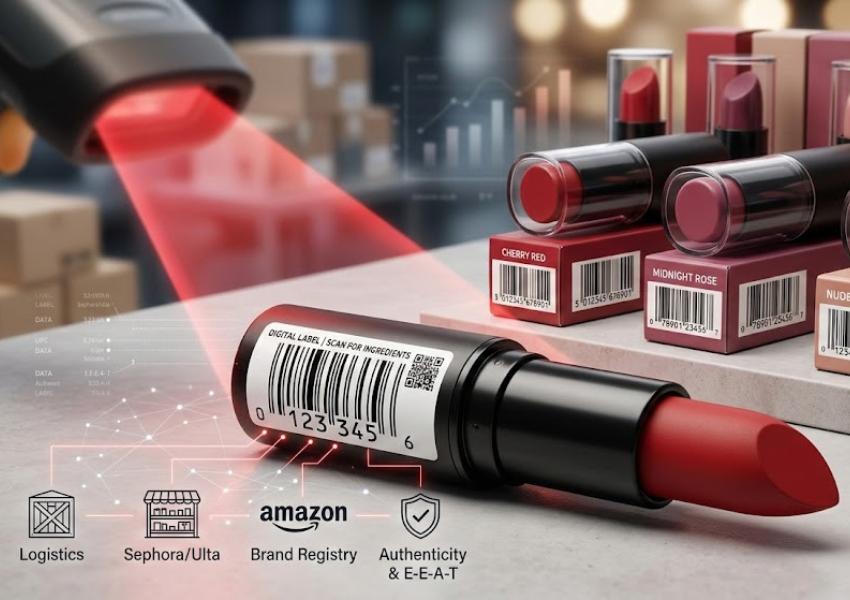
In the multi-billion dollar beauty industry, success is often defined by the “swatch” the perfect pigment, the creamy texture, and the luxury packaging. However, behind the glamour of a high-end lipstick lies a complex web of logistics, data, and global standards. At the heart of this web is a small, often overlooked series of black and white lines: the lipstick barcode.
While it may seem like a minor detail, the lipstick barcode is the “digital DNA” of the product. It governs everything from how a product is tracked in a warehouse to how it is sold in a boutique in Paris or a drug store in New York. For brand owners, failing to understand the nuances of barcoding can lead to rejected shipments, massive fines, and lost consumer trust.
In this comprehensive guide, we will explore the technical specifications, strategic importance, and future trends of barcodes in the cosmetics sector.
The Anatomy of a Lipstick Barcode: Technical Standards
Not all barcodes are created equal. Because lipstick tubes are uniquely shaped often thin, cylindrical, or exceptionally small the “standard” barcode used on a cereal box often won’t work.
UPC vs. EAN: The Global Language
The two most common types of barcodes used on lipstick packaging are the UPC (Universal Product Code) and the EAN (European Article Number).
-
UPC-A: Primarily used in North America, this 12-digit code is the gold standard for retail.
-
EAN-13: Used internationally, this 13-digit code is necessary if you plan to sell your lipstick in Europe, Asia, or Australia.
The Challenge of Small Packaging: UPC-E
One of the biggest hurdles in the beauty industry is “real estate.” A slim “matte liquid lipstick” or a “precision lip liner” doesn’t have enough flat surface area for a standard 12-digit UPC-A barcode.
This is where the UPC-E comes into play. It is a “zero-suppressed” version of the barcode that condenses the data into a much smaller footprint. By eliminating unnecessary zeros in the data string, brands can maintain scan ability without sacrificing the aesthetic design of their luxury packaging.
2D Codes and Data Matrix
As we move toward “Smart Packaging,” many brands are adding a second code. While the linear barcode handles the checkout process, a Data Matrix or QR Code can hold much more information, such as:
- Full ingredient lists (to comply with FDA or EU regulations).
- Batch numbers and expiration dates.
- Links to “How-to” video tutorials.
Why Every Shade Needs a Unique Barcode
A common mistake among startup beauty brands is the “Universal Barcode Myth”—the idea that you can use one barcode for an entire lipstick line.
This is a logistical disaster.
SKU Proliferation
In the world of inventory management, each variation of a product is called a SKU (Stock Keeping Unit). If your “Midnight Rose” lipstick has the same barcode as your “Cherry Red” lipstick, a retailer’s computer system cannot tell them apart.
- Inventory Accuracy: When a customer buys “Midnight Rose,” the system needs to deduct one unit of that specific color from the stock.
- Automated Reordering: If the barcode is shared, the system might see that you have 100 lipsticks in stock and not realize that you are sold out of the best-selling red while sitting on 100 units of an unpopular purple.
The Role of GTINs
The barcode is simply the visual representation of the GTIN (Global Trade Item Number). Each shade must have its own unique GTIN assigned through an official body like GS1. This ensures that your product’s data is unique across the entire global supply chain.
Barcodes as a Tool for Authenticity and E-E-A-T
Google’s search algorithms prioritize content that demonstrates E-E-A-T. In the context of a barcode website, this means proving that you understand the “trust” factor that barcodes provide to consumers.
Fighting the Counterfeit Crisis
The global cosmetics industry loses an estimated $5 billion annually to counterfeit products. These fakes are not just a financial threat; they are a health hazard, often containing lead, arsenic, or bacteria.
A verified lipstick barcode allows a consumer to:
-
Scan and Verify: Use mobile apps to check if the GTIN is registered to the actual brand owner.
-
Verify Provenance: Ensure the product was manufactured in an authorized facility.
-
Cross-Reference Packaging: Match the barcode data with the batch code printed on the bottom of the tube.
By providing legitimate barcodes, a brand signals to both Google and the consumer that they are a “Trustworthy” and “Authoritative” entity in the market.
The Logistics of “Beauty Retail”: Sephora, Ulta, and Amazon
If your goal is to get your lipstick onto the shelves of major retailers, your barcoding must be flawless. Retailers like Sephora and Ulta have strict Vendor Compliance Manuals.
Warehouse Management Systems (WMS)
When your shipment arrives at a retailer’s distribution center, it isn’t opened and counted by hand. High-speed scanners read the barcodes on the outer cartons (GTIN-14) and the individual lipstick tubes. If the barcodes are unreadable or incorrectly mapped:
- The shipment may be rejected.
- The brand may be issued a “chargeback” (a financial penalty).
- The relationship with the buyer can be damaged.
Amazon Transparency and Brand Registry
For brands selling on Amazon, barcodes are the ticket to entry. Amazon requires a unique GTIN for every listing. Furthermore, by using Amazon Transparency codes (a specialized type of 2D barcode), brands can prevent “piggybacking” by unauthorized third-party sellers, ensuring that every lipstick sold under their name is the real deal.
Design and Printing: Ensuring 100% Scan ability
A barcode is only useful if it scans. In the beauty world, designers often want to change the color of the barcode to match the branding (e.g., a gold barcode on a black tube). This is a dangerous move.
The Physics of the Red Light
Most retail scanners use red light. To a red-light scanner, red, orange, and gold lines are “invisible” they look like white space.
- Best Practice: Always use high-contrast combinations. Black lines on a white or cream background are the safest.
- The Quiet Zone: Every barcode requires a “Quiet Zone” a margin of empty space around the code. If text or graphics bleed into this zone, the scanner won’t be able to find the start or end of the code.
Curvature Issues
Because lipstick tubes are cylindrical, the barcode must be oriented correctly. If a barcode is wrapped too tightly around a thin tube, the scanner cannot “see” both ends of the code simultaneously. In these cases, a “Ladder Orientation” (vertical lines) is often preferred over a “Picket Fence” (horizontal lines) to account for the curve of the packaging.
Regulatory Compliance and the “Barcode Link”
In many regions, barcodes are becoming a legal necessity for ingredient transparency. The MoCRA (Modernization of Cosmetics Regulation Act) in the US and similar laws in the EU are pushing for better traceability.
The Digital Label
With limited space on a lipstick tube for 50+ ingredients, many brands are using barcodes to link to a “Digital Label.” By scanning the lipstick barcode or an adjacent QR code, consumers can immediately access:
- Allergen information.
- Vegan/Cruelty-free certifications.
- Sustainability data (how to recycle the tube).
How to Obtain a Lipstick Barcode: Step-by-Step
For a brand owner, the process of getting a barcode should be handled with precision.
- Calculate your SKUs: Count every color, finish (matte vs. gloss), and size. If you have 10 shades, you need 10 unique barcodes.
- Determine your Market: Are you selling only in the US (UPC) or globally (EAN)?
- Register with GS1 or a Trusted Reseller: Ensure your prefix is registered so that your brand name appears when the code is scanned.
- Integrate into Design: Work with your packaging designer to ensure the “Quiet Zone” and “Magnification” (size) meet retail standards.
- Test Print: Always perform a scan test on the physical packaging before ordering a production run of 10,000 units.
The Future: RFID and Beyond
As we look toward the future of the beauty industry, the “lipstick barcode” is evolving. RFID (Radio Frequency Identification) tags are beginning to appear in high-end cosmetic displays. These allow a store to track inventory in real-time without even scanning the item. However, for the foreseeable future, the traditional barcode will remain the most cost-effective and universal tool for the beauty industry.
Conclusion: Small Lines, Big Impact
The lipstick barcode may be the smallest part of your packaging, but it is the bridge between your product and the global marketplace. It ensures that your brand is professional, your inventory is accurate, and your consumers are safe.
Whether you are a consumer looking to verify your latest purchase or a brand owner ready to scale, understanding the technical and strategic value of the barcode is a must. In the world of beauty, precision is everything—and that precision starts with a scan.






Leave a Reply